

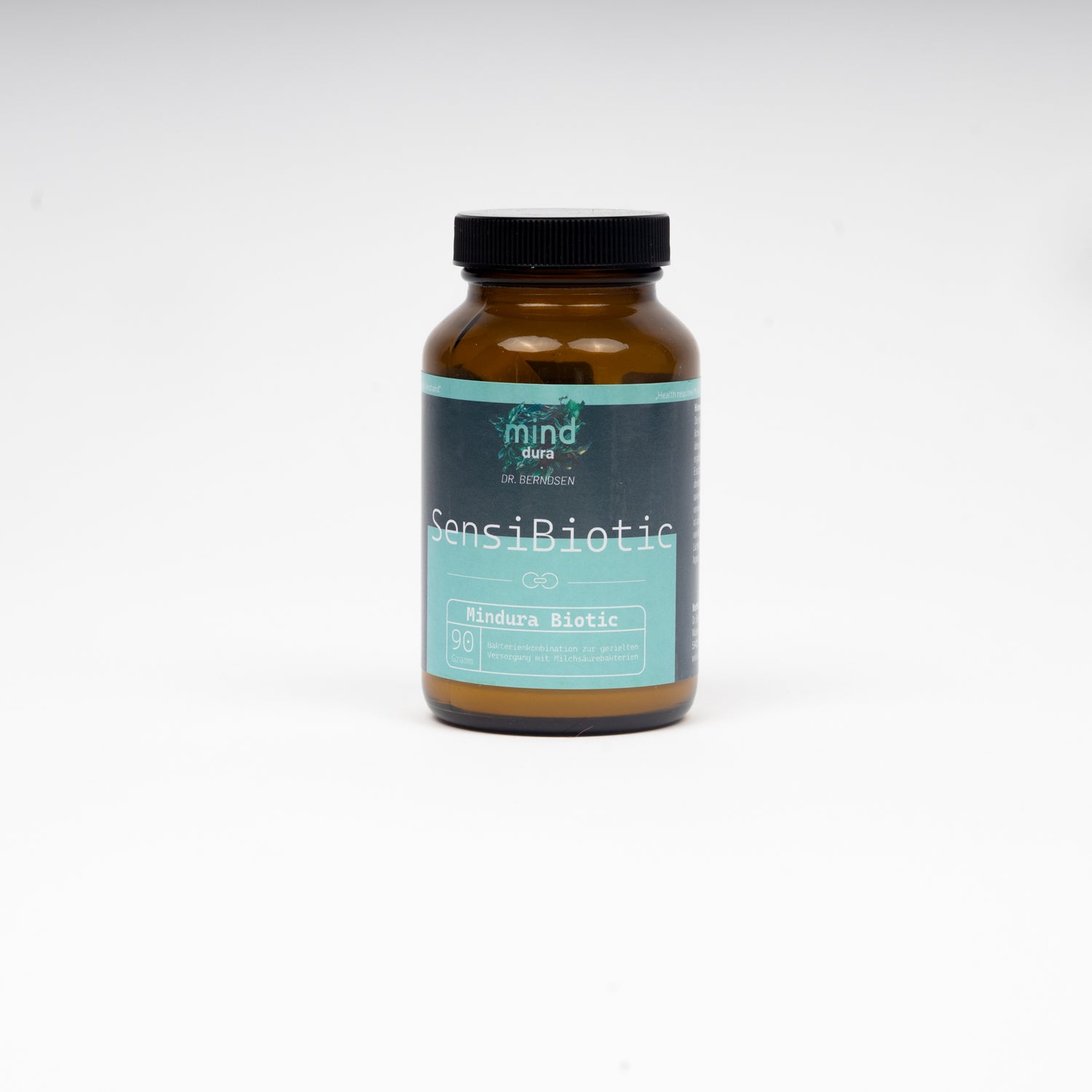
Mindura SensiBiotic
Food supplement with six bacterial cultures.
Product description
Product description
- 6 gut-friendly bacterial strains
- a microbial opportunity to reduce the effects of histamine
- 5x10⁹ CFU per daily dose
- Powder for dissolving in liquid
- Neutral taste
- Individual dosing possible
Recommended intake
Recommended intake
When using for the first time, start with 1 level measuring spoon daily and increase to a daily dose of 3 measuring spoons within 10 days. Take the daily amount in the morning before a meal, dissolved in cold or lukewarm liquid.
1 measuring spoon (1.0 g) … bacterial count … 1.7 x 10⁹ CFU**
2 measuring spoons (2.0 g) … bacterial count … 3.4 x 10⁹ CFU**
3 measuring spoons (3.0 g) … bacterial count … 5.1 x 10⁹ CFU**
**CFU: colony-forming units
Ingredients & Composition
Ingredients & Composition
Maltodextrin, bacterial cultures
Mindura SensiBiotic contains six selected bacterial cultures with a high total activity
Bifidobacterium infantis CNCM I-5090
Bifidobacterium longum CNCM I-5097
Lacticaseibacillus rhamnosus INRA/CIRM-BIA 1113
Lactobacillus gasseri CNCM I-5076
Ligilactobacillus salivarius CNCM I-5114
Limosilactobacillus reuteri INRA/CIRM-BIA 929
Ingredientsper daily dose (3g)NRV*Bacterial cultures5.1 x 10⁹ CFU**–*Nutrient Reference Value**CFU: colony-forming units
Notes
Notes
Important note:
Mindura SensiBiotic is not intended for acute allergic reactions that require medication or a visit to a doctor.
Do not exceed the stated recommended daily intake. Food supplements should not be used as a substitute for a balanced and varied diet and a healthy lifestyle. Keep out of the reach of young children. Store in a cool, dry place protected from light.
Couldn't load pickup availability

- 6 gut-friendly bacterial strains
- microbial opportunity – to reduce the effects of histamine
- 5x10⁹ CFU per daily dose
- powder for dissolving in liquid
- neutral taste
- individual dosing possible
When using for the first time, start with 1 level measuring spoon daily and increase to a daily dose of 3 measuring spoons within 10 days. Take the daily amount in the morning before a meal, dissolved in cold or lukewarm liquid.
1 measuring spoon (1.0 g) … bacterial count … 1.7 x 10⁹ CFU**
2 measuring spoons (2.0 g) … bacterial count … 3.4 x 10⁹ CFU**
3 measuring spoons (3.0 g) … bacterial count … 5.1 x 10⁹ CFU**
**CFU: colony-forming units
Maltodextrin, bacterial cultures
Mindura SensiBiotic contains six selected bacterial cultures with a high total activity
Bifidobacterium infantis CNCM I-5090
Bifidobacterium longum CNCM I-5097
Lacticaseibacillus rhamnosus INRA/CIRM-BIA 1113
Lactobacillus gasseri CNCM I-5076
Ligilactobacillus salivarius CNCM I-5114
Limosilactobacillus reuteri INRA/CIRM-BIA 929
Ingredientsper daily dose (3g)NRV*Bacterial cultures5.1 x 10⁹ CFU**–*Nutrient Reference Value**CFU: colony-forming units
Important note:
Mindura SensiBiotic is not intended for acute allergic reactions that require medication or a visit to a doctor.
Do not exceed the stated recommended daily intake. Food supplements should not be used as a substitute for a balanced and varied diet and a healthy lifestyle. Keep out of the reach of young children. Store in a cool, dry place protected from light.

How Mindura® SensiBiotic supports you
Comprehensive gut health
Understanding histamine in the body: Histamine acts as an essential tissue hormone and signalling molecule in the human organism. It is involved in numerous processes in the body.
Benefits of Mindura® SensiBiotic for everyone: Mindura® SensiBiotic was developed for daily use. The combination of six selected lactic acid bacteria strains is carefully matched.
What's inside Mindura® SensiBiotic:
Six selected bacterial cultures with high overall activity, combined in one preparation for daily use.
Gut flora and holistic health: Your gut flora is home to numerous bacterial strains that exist in a complex balance with one another. The cultures contained in Mindura® SensiBiotic have been carefully selected and matched to one another.
The composition: With its balanced composition, Mindura® SensiBiotic is intended for daily use.

What makes our Mindura Biotic® SensiBiotic special


Frequently asked questions
How do I know if I have elevated histamine levels?
How do I know if I have elevated histamine levels?
Histamine levels can be measured either through a test at a doctor's surgery or through a self-test using blood or stool.
Do I need to measure my histamine levels before using the product?
Do I need to measure my histamine levels before using the product?
In principle, you can take Mindura® SensiBiotic regardless of your histamine levels. It is very useful, for example, if there is a dysbalance, i.e. an imbalance in the gut.
Can Mindura® Sensibiotic be taken with fermented foods?
Can Mindura® Sensibiotic be taken with fermented foods?
Yes, you can take Mindura® Sensibiotic together with fermented foods. However, experts advise caution with fermented foods if you have histamine intolerance, so as not to provoke any symptoms.
Is there anything I should bear in mind regarding the dosage?
Is there anything I should bear in mind regarding the dosage?
If you are taking preparations containing lactic acid bacteria for the first time, you should generally start with a gradually increasing dose during the first 1–2 weeks. This reduces unwanted intestinal activity and prepares your gut for taking in the lactic acid bacteria. In addition, the dose should also be adjusted if children or adolescents take Mindura SensiBiotic.
Mindura®
Food supplements
-

Acacia fibre
Soluble dietary fibre from pure acacia fibre. This dietary fibre, also known as prebiotics, is essential for the well-being of your gut.
-

Curcumin
Curcumin and piperine
Curcumin is the pigment of turmeric; piperine from black pepper supports absorption. -

Omega 3 + Vitamin E
Contains eicosapentaenoic acid (EPA) and docosahexaenoic acid (DHA)